
Before the first investment
Which business problems justify exploring AI, and which organizational conditions need attention before committing resources?
Assessments / AI Readiness
A consultant-led assessment of your organization's readiness, opportunities and constraints—bringing evidence into the decisions that come before investment, piloting and scale.
The decision ahead
Which business problems justify exploring AI, and which organizational conditions need attention before committing resources?
Which candidate use cases offer a credible path to value, given the available data, people, technology and risks?
What has to improve in ownership, capability and oversight before AI becomes part of everyday operations?
What we examine
An attractive use case may still depend on data that is difficult to use, processes that need redesign or responsibilities that have yet to be agreed.
We examine seven connected dimensions through 49 subdimensions. Documents, interviews and opportunity discussions provide the context for professional judgments about capability, confidence and the adequacy of supporting evidence.
The official aggregate requires all 49 judgments to be reviewed and adequate evidence across all seven dimensions. Findings and evidence limitations remain part of the assessment narrative.
How the engagement works
Nine engagement stages connect the initial scope with the final report and leadership presentation. The work is organized around four questions: what matters, what is supported, what comes first and what should happen next.
Agree objectives, boundaries, stakeholders and working arrangements through pre-engagement and kick-off.
Review documents, interview stakeholders and explore opportunities before developing and reviewing the readiness judgments.
Consider use-case value, feasibility and risk together, then connect the priorities to a sequenced roadmap.
Bring the report and supporting outputs through quality review and approval, then discuss the recommendations with leadership.
What you take forward
Six connected outputs help leadership and working teams understand the findings and act on the priorities. The scope establishes the coverage and delivery arrangements.
An integrated account of the context, evidence, findings and recommendations.
A structured view of readiness, supported by reviewed judgments and evidence adequacy.
A comparison of opportunities, their enabling conditions and recommended priorities.
A record of identified risks, controls and the matters that need further attention.
Sequenced actions across workstreams, with owners, dependencies and decision points.
A concise decision narrative for sponsors and leadership discussions.
Before we begin
An initial conversation can start with a short description of the problem and the decision ahead. These four areas help us agree a useful scope.
Describe the decision the assessment should inform, the organizational scope and the sponsor who can bring the relevant people together.
Identify stakeholders across business operations, data, technology, people and governance who can explain the current conditions.
Bring relevant strategy and process documents, information about data and systems, existing policies and any previous AI initiatives. Gaps in the evidence can be recorded and discussed.
Share the problems or use cases already being considered, including intended users, expected improvements and known constraints.
For the first inquiry, describe the context briefly. Detailed document access and evidence arrangements can be agreed during scoping.
Supported by the platform
A shared workspace for the evidence, judgments and decisions behind the assessment.
The Utomo AI Readiness Platform supports the engagement from evidence review to versioned deliverables. Explore the actual screens and see how the stages connect.
Explore the platform ↗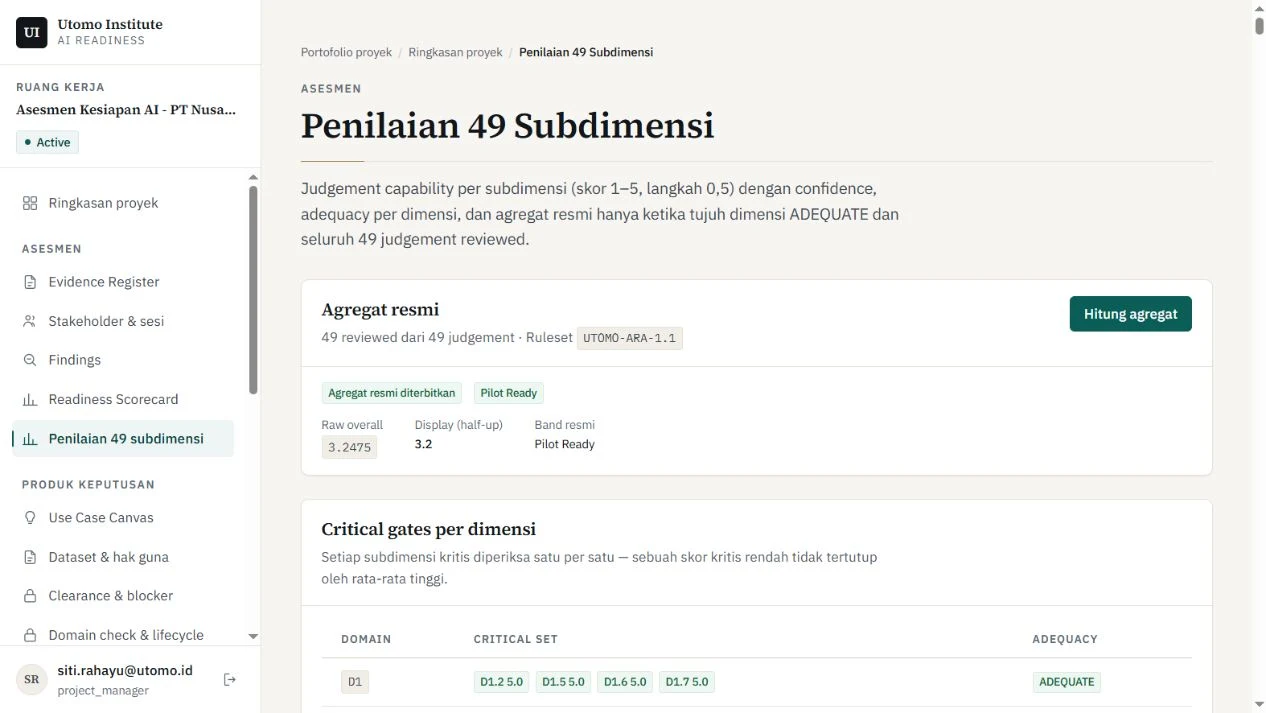
Actual platform interface with demonstration data.
Practical questions
No. The assessment can begin with a business problem or an investment question. Candidate use cases and possible next steps are explored in the context of your organization.
The engagement starts with the evidence available. Missing information and evidence limitations are recorded; additional material or interviews may be needed. An official readiness aggregate requires reviewed judgments and adequate evidence across all seven dimensions.
A sponsor and a coordinating contact help establish the engagement. Participation then follows the agreed scope, with relevant business, process, data, technology, people and governance stakeholders contributing evidence and context.
Timing is agreed after scoping. It depends on the organizational coverage, stakeholder availability, quality of existing evidence and number of use cases under consideration. We confirm a working plan before the assessment begins.
The core output set comprises an assessment report, readiness scorecard, use case matrix, risk register, implementation roadmap and executive presentation. Coverage and delivery arrangements are confirmed in the engagement scope.
The assessment establishes findings, priorities and a roadmap. Pilot delivery or implementation can be discussed as a subsequent engagement with its own objectives, responsibilities and success measures.
The AI Readiness Platform supports evidence organization, assessment judgments, use-case comparison, roadmap development and review of deliverables. Consultants remain responsible for the analysis and recommendations.
No. The platform's optional AI Copilot requires project opt-in and written client consent. Its use is discussed explicitly; it is not a prerequisite for the assessment.
Start with your organization
Tell us the objective, the part of the organization involved and the opportunities you are considering.