
01
Reference-based answers
A knowledge collection drawn from official Hajj and Umrah guidance provides the starting context for questions about manasik and the practice of pilgrimage.
Virtual Mutawwif / Hajj & Umrah knowledge assistant
Pendamping manasik melalui WhatsApp, dengan jawaban yang berpijak pada rujukan.
Make reference-based information easier to reach when pilgrims have questions about Hajj and Umrah.
Virtual Mutawwif uses Retrieval-Augmented Generation (RAG) to find relevant passages before composing a response. It supports pilgrims and their guides with answers informed by a prepared collection of official reference material.
The need
Pilgrims may have questions between guidance sessions or close to important moments in their journey. Their guides, meanwhile, often receive the same questions repeatedly.
A fluent AI answer can sound convincing even when its basis is unclear. For questions about worship, the relationship between the answer, the reference and the pilgrim's circumstances matters.
Virtual Mutawwif begins by retrieving relevant material. Its purpose is to make that knowledge more accessible and support the conversation between pilgrims and qualified guides.
Inside the product
Pilgrims ask through WhatsApp; the reference and retrieval workflow operates behind the conversation. The product introduction below illustrates the intended experience.
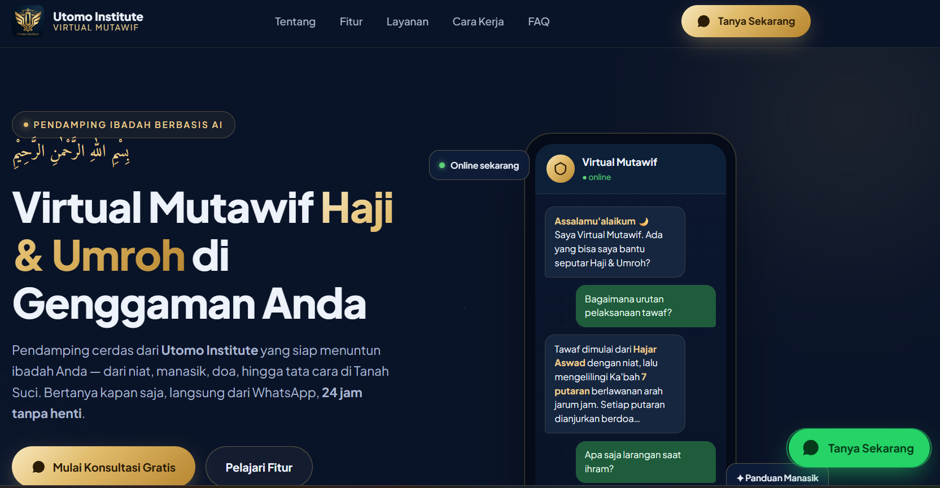
From question to answer
RAG connects a language model with an external reference collection. The response is shaped by the material retrieved for the question, rather than relying only on the model's internal knowledge.
A pilgrim sends a question through WhatsApp. The channel and orchestrator pass it into the answering workflow.
The system searches the prepared reference collection for passages relevant to the question.
An AI evaluator assesses whether the retrieved context is sufficient. If needed, the workflow seeks additional material from designated official websites.
The selected context and original question guide the generated response, keeping the answer connected to retrieved material.
Designated supplementary sources
Source selection follows the subject of the question. These links identify reference sources; they do not imply institutional endorsement of the application.
Core capabilities
01
A knowledge collection drawn from official Hajj and Umrah guidance provides the starting context for questions about manasik and the practice of pilgrimage.
02
Pilgrims can submit questions through a familiar messaging channel, including outside scheduled guidance sessions. The channel uses a third-party provider and depends on the deployed service being available.
03
Sentence, paragraph and proposition-based chunking create complementary ways to retrieve information from the same reference collection.
04
When internal context is assessed as insufficient, the workflow retrieves supplementary information from designated official sources and combines it with internal candidates.
05
Routine questions can receive an initial reference-based response, giving guides more room for direct teaching and cases that require personal attention.
06
Researchers can examine retrieval relevance, context sufficiency and answer faithfulness. Source grounding is an approach to reducing unsupported answers, not evidence that errors have been eliminated.
Who it supports
Ask routine manasik questions through WhatsApp and prepare for a more informed discussion with a guide.
Offer an additional channel for recurring questions while keeping direct teaching and individual guidance central.
Explore a reference-based approach to supporting recurring public inquiries within an agreed service scope.
Evaluate retrieval, source relevance and answer reliability, and identify where the system needs improvement.
Illustrative use cases
A pilgrim asks about the sequence or conditions of a ritual. The assistant retrieves relevant guidance as a starting point for understanding.
A question is not adequately covered by the internal collection. The workflow seeks relevant information from the designated official websites before composing an answer.
A KBIHU team directs routine questions to the assistant and reserves face-to-face time for teaching, individual circumstances and points that need clarification.
For service teams & researchers
The described ingestion pipeline uses agentic chunking at sentence, paragraph and proposition level. Local BGE-m3 embeddings are stored in Qdrant with source metadata, so retrieved passages retain their reference context.
Retrieval across the three granularities produces candidates whose rankings are combined through Reciprocal Rank Fusion (RRF). The described generation stage uses five selected context passages alongside the original question.
An LLM-as-a-Judge step evaluates context sufficiency. When it flags a gap, an on-demand crawler seeks additional material from designated official sites and combines it with internal candidates. This evaluation can itself be wrong and should be included in reliability testing.
The supplied architecture uses MiMo V2.5-Pro for generation, a third-party WhatsApp channel and VPS or local-server hosting. Evaluation can examine source relevance, faithfulness, unsupported statements and the treatment of insufficient context. No measured accuracy or uptime result is claimed here.
The role of the assistant
Retrieved references help ground a response. They do not guarantee that every answer is complete or that it fits an individual's circumstances.
Questions involving a personal obligation, an exception, a disputed interpretation or a time-sensitive decision should be confirmed with a qualified pilgrimage guide or relevant authority.
A useful deployment keeps the reference collection maintained and makes room for review when the available context is insufficient. Virtual Mutawwif supports guidance; it does not replace the responsibility of a qualified guide.
Explore Virtual Mutawwif
Discuss the knowledge collection, WhatsApp service, guidance workflow and evaluation approach in a demonstration.